

How To Come Back From Anything (Game Theory)
The instinct to fix it fast is the very instinct that guarantees you will not even make it to the next round.


No fancy introduction or ornamentation for this article. You have read the title. You know what it is all about.
Let me state one fact in the clearest possible way: This is not self-help.
I will not suggest reading three books a day. Nor will I ask you to “just get a gym membership.” That is insufficient advice, and you know it by now.
Instead, I will treat you as an intelligent adult while demanding your attention and funneling it strictly toward game theory.
Toward strategy over ambiguous philosophies.
Toward compounding progress rather than static positions.
If you are doing well right now, consider saving this article. It is always a favorable idea to save an exit route in this unpredictable world.
Contents Include:
The Truth About The Comeback
Precept 1: Survive the Round First.
Precept 2: When Behind, Add Variance.
Precept 3: You Cannot Rebuild at the Same Speed You Broke
Precept 4: Stop Paying Into Lost Positions
The Truth About The Comeback
You can come back from almost anything. That is a plain fact. You and nearly everyone else in this world already know that.
Until you are caught in a situation that demands a comeback.
Suddenly, all your prior escape routes, if you have prepared any, seem inaccessible or blocked. You begin fearing the idea of “building anew,” so you find yourself scrambling for ideas to plot a ‘recovery attempt.’
This is what causes just about every single great collapse.
Understand this: a flawed recovery attempt is worse than the initial fall simply because it opens pits no one could ever hope to anticipate.
This is where game theory steps in. It explains what caused your downfall and prescribes the exact, counterintuitive sequence that gets you back into the game.
PRECEPT 1: Survive the Round First.
You do not have to win the round you lost. But you need to survive it.
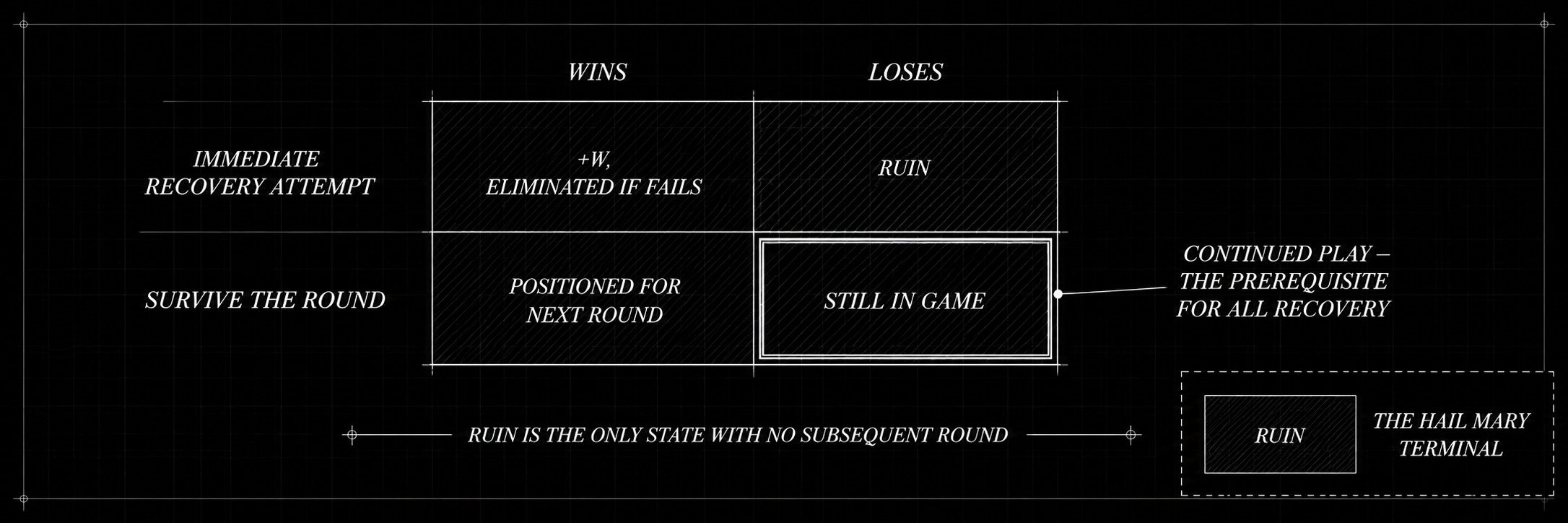
Whenever you lose something, your first instinct will always be to reach for an immediate recovery.
Usually, it manifests as a commitment to an initiative meant to erase all your losses in one single stroke. Remortgage on the comeback trade—all in to win it straight back tonight.
Surely, you already recognize it to be nothing more than a delusional Hail Mary. Yet you do it all the time.
The white lie in relationships.
The act of rapidly panic-selling stocks.
The immediate desire for revenge when crossed.
And it always ends the same way: you end up making it significantly worse than before for everyone involved and have now effectively opened an even deeper pit for yourself.
What you must understand is that just about every single game worth being in is an “iterated” game: one consisting of multiple rounds, where each round affects subsequent engagements.1
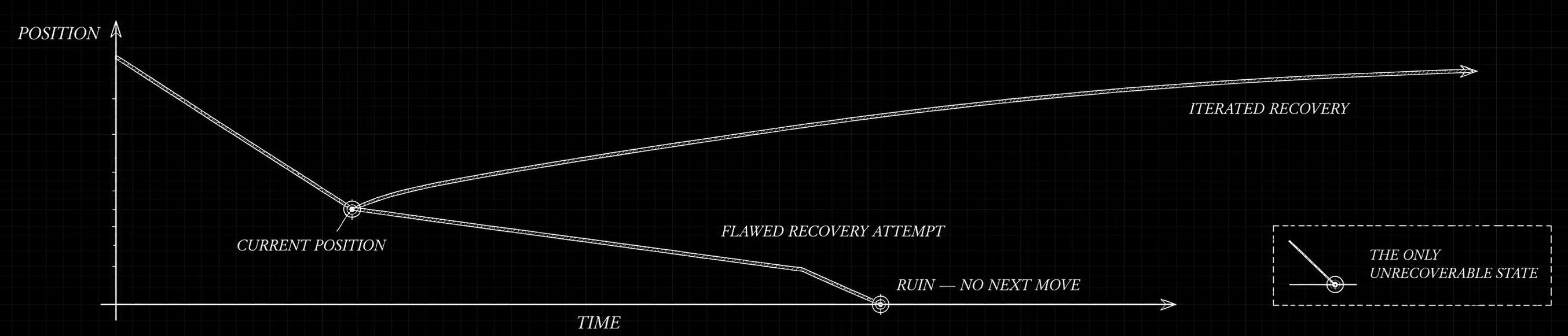
The future rounds are where recovery is meant to happen. Losing the current round does not automatically eliminate you from participating in the next phases.
Despite that, there exists precisely one singular state you cannot recover from: total elimination.
Absolute ruin is the only irreparable position. It offers no opportunity to participate in the subsequent phase of an iterated game, forcing you out for all time.
Committing to one last desperate act inadvertently creates the ideal downward spiral into your very own ruin. It is a bitter irony. All your resources, time, money, and focus will melt away just for one delusional shot at erasing a bad round.
In the process, you are gambling away the one thing that makes recovery even feasible: continued play.
It is akin to a doctor amputating your arm because you have a minor infection in a hemorrhaged index finger. The irrationality knows no bounds.
The Reversal: Survive Before You Thrive
Stop the bleeding first. Plan the return afterward.
Most of your downfalls are a cut at the calf. A movement-restricting annoyance, but it will not kill you outright. At least as long as you do not try running a marathon with it. The infected wound is the harshest death because everyone knows that it could have been treated.
The first move of an excellent comeback is therefore not a win. The first move is the attempt not to be permanently eliminated. You must preserve enough capital, credibility, health, or autonomy to return to the table in the next round.
Cut the loss and secure a solid floor before the situation turns into a bottomless pit—that is the first act of the comeback.
Learn to acknowledge that staying in the game is boring, unheroic, and the entire ballgame.
PRECEPT 2: When Behind, Add Variance.
After a downfall, you will inevitably find yourself assuming that you must “grind harder” along the concrete line that led you to your loss. More hours, more intensity, same strategy.
“I just need more of everything!”
The volume game fallacy.
Now, do not deceive yourself and think honestly about it. You will realize this is just rehearsing the same loss for the sake of it. Unless you are a deranged masochist, you should avoid this mindset, because the floor does not get softer the more you fall onto it. In fact, it will break down and sentence you to even lower depths.
The “grind harder” strategy is basically just the Hail Mary gamble in a more deceitful disguise. It surely looks like effort, and it probably is. That does not imply that it is good, though.
At least the gamble from Percept 1 either saves you or permanently terminates the game for you. The common grinding strategy does neither.
You risk rearranging the game around your losses and trapping yourself in a perpetual loop of increasing workload while decimating your payoffs. This is pure reactivity, and you will ultimately find yourself building sandcastles in an hourglass.
Committing to a strategy that bears all the risks of a gamble and none of the payoff is worse than choosing between fighting or folding. It also changes nothing about what caused the loss in the first place.
Stop feeding the loop at once.
The Reversal: Change the Shape of the Bet.
If your current trajectory reliably produces losses, you need to commit to moves that widen the distribution. Unconventional moves, asymmetric bets—the doors no individual in a safe position would even consider opening because they are that uncomfortable.
This is not a lesson in total recklessness. This is not about encouraging you to take a ginormous gamble that risks eliminating you entirely.
It is about the realization that you, in your position of loss, possess one strategy that no one else possesses: the ability to abandon the safe line.
Analyze what led to your prior loss, visualize its trajectory, and then take a different path from there. Take any chance to deviate from the trajectory that led to failure, regardless of how outlandish it seems.
The position at the bottom gives free rein to experiment.
Likewise, a chess player in a losing position will not trade pieces. He knows that trading simplifies the board, and a simpler board favors whoever is currently ahead. Fewer pieces means fewer chances for the losing side to generate a tactic, after all.
So, the losing player deliberately makes the position messier and harder to calculate. A chaotic board at least contains a mistake the opponent might make.
He manufactures variance because clarity would kill him.
PRECEPT 3: You Cannot Rebuild at the Same Speed You Broke
Restore it all in one grand gesture. One dramatic move, a big announcement, the one act that will erase the fall and put everything back in place.
Similar identity to the gamble, yet fundamentally different. You will have a natural inclination toward this idea in particular because it creates a narrative.
Contrary to precept 1, the usual idea behind this strategy is not a desperate gamble but a sudden construction of a second empire. Such an idea is seductive to you for all the right reasons, yet leads to all the wrong decisions.
Destruction and construction are asymmetric in every domain. Construction is almost linear in its appearance, whereas destruction is exponential.
A reputation, a fortune, a skill, a body, a relationship: each is built additively over an extended run of consistent inputs, yet each can be destroyed in just one or two simple actions.
Even worse, stating that you intend to rebuild faster appears fake due to the emphasis on speed itself. Speed is a signature of a cheap signal. It is simply something anyone could assert at virtually any time.
As such, announcing that you have “completely changed” just one day after a catastrophe is both a comedically ridiculous sentence to utter while somehow also managing to be the cheapest sentence you could have constructed in the entire realm of language.
The Reversal: Use Time as the Signal
Time is the only thing that cannot be cheaply faked. Consistent performance across a span long enough that a pretender would have already quit is the single highest source of credibility you could attain.2
It is, quite literally, uncheatable proof, regardless of who your audience might be. Whether they are a lender, an employer, or a partner is not relevant.
If your comeback is contingent on the dependency that other people believe in a new version of you, then pay in a currency they can verify. A sustained cost of your time rather than a promise tainted by cheap talk.
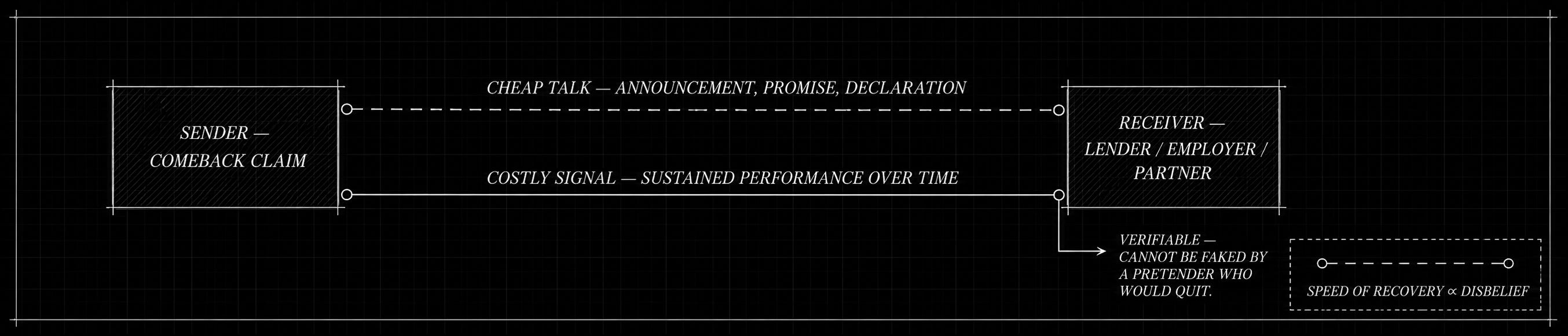
The speed of your recovery is inversely proportional to how much any person believes it.
PRECEPT 4: Stop Paying Into Lost Positions.
“I have put three years/my savings/my whole reputation into this—I cannot walk away now!”
This is the sunk-cost fallacy expressed aloud. And particularly in today’s world, this is the most frequent and expensive decision a mind can make.
Resources you have already spent are gone, regardless of whether their investment paid off or not. They also convey exactly zero information about whether the next dollar, hour, or year is even worth spending.
“But I have already put so much in!” is the flawed reasoning a person uses before they convert a completely recoverable loss into a total collapse because they cannot get themselves to stop funding dead projects.
You need to spare the resources you still have. They are your only chance at making a comeback. Without them, you are doomed.
No one will explain it that plainly for you.
The Reversal: Forget the Past and Enter the Present.
There is no need to pretend that this is not the trickiest advice to adhere to in this entire article.
Your past decisions should remain in the past. Buried deep underground, locked in a place where it cannot influence you. The sole reason to revise a decision is to analyze it without permitting it to sway your judgments. Everything else is a brilliantly executed self-deception—a fable tainted by sunk costs, now masquerading as your own decision. 3
The only escape is to price every decision from the present as if you have just arrived and the past investments belonged to someone else entirely.
Only one single question is allowed to roam inside your mind: given today’s position, is continuing here the best available use of what I have left?
If a stranger in your position cut it, then cut it. The money, time, and pride are already spent. The payoff, or lack thereof, is a lesson. One that will stick with you, sharpen you.
Either way, the investment is gone. At this point, you must decide how much more you are willing to lose.
A Final Diagnostic
Most people do not lack the skill to pull off a comeback. In most cases, they lack the rationality and clarity required to survive a crisis.
When overloaded with emotion and fear, the rational choice happens to be the choice that feels the most inaccurate, yet is the only decision that offers a realistic escape.
This article is more like a survival guide than an advisorial piece. And you should use it accordingly.
The average person can hide in their blissful ignorance, asserting that “they just did not know how to react.” But today, you lost the right to this superficial excuse.
Descend Deeper:
If you found this useful, this is the free tier. The paid library goes considerably further. There is a lot more to uncover.


Axelrod, R. (1984). The Evolution of Cooperation. Basic Books.
Friedman, J. W. (1971). A non-cooperative equilibrium for supergames. Review of Economic Studies, 38(1), 1–12.
Spence, M. (1973). Job market signaling. Quarterly Journal of Economics, 87(3), 355–374.
Crawford, V. P., & Sobel, J. (1982). Strategic information transmission. Econometrica, 50(6), 1431–1451.
Arkes, H. R., & Blumer, C. (1985). The psychology of sunk cost. Organizational Behavior and Human Decision Processes, 35(1), 124–140.
Thaler, R. H. (1980). Toward a positive theory of consumer choice. Journal of Economic Behavior & Organization, 1(1), 39–60.
Precepts 1 and 2 pull against each other and the resolution is the interesting part. Widening the distribution raises the odds of the one outcome you named as unrecoverable. The chess analogy holds because a lost game costs nothing beyond the loss, but an iterated game with real elimination is different. Which means variance is only available after the floor is set, and specifically only in the portion of the position that sits above it.
Have we met before?